
 English
 English (US)
 English (AU)
 English (NZ)
 English (SA)
 Français
 Français (CA)
 Italiano
 Deutsch
 Español
 Nederlands
 Português
 Polski
 العربية
 עברית
עברית Svenska
 Dansk
Dansk Suomi
Suomi Norsk
Norsk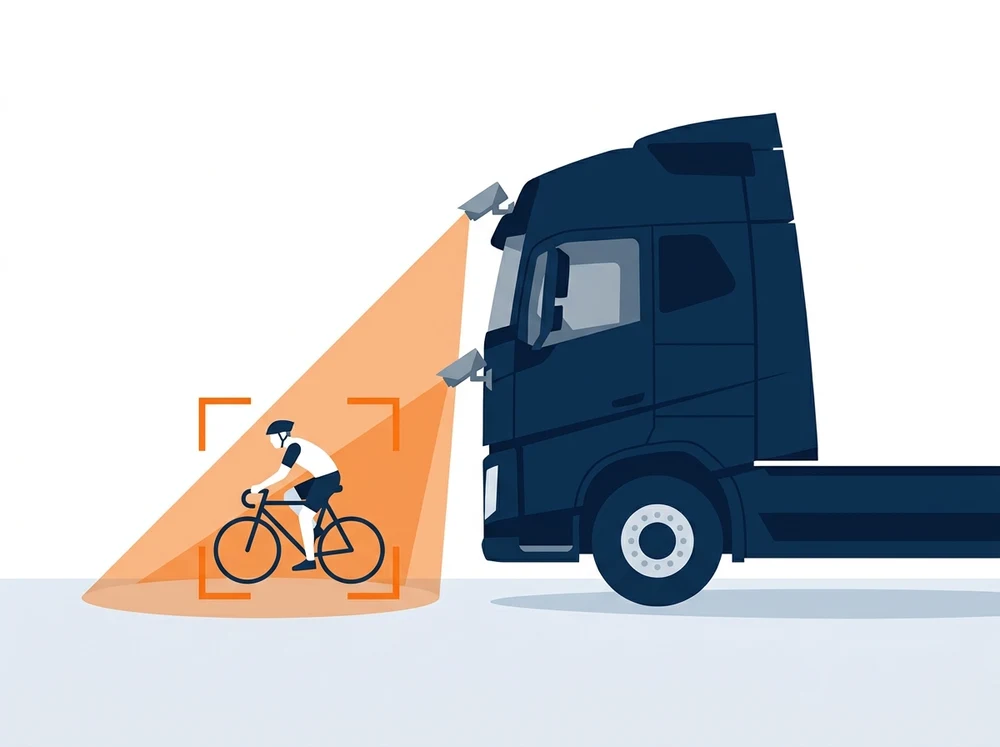
If your trucks go anywhere near Greater London, the Direct Vision Standard isn't optional reading — it's the difference between operating legally and facing a £550 penalty charge per day of non-compliance.
Since 28 October 2024, under Phase 2 of Transport for London's scheme, every HGV over 12 tonnes needs a minimum three-star DVS rating — or a fully fitted Progressive Safe System (PSS) — to hold the HGV Safety Permit required to operate in Greater London. Most fleet workhorses on UK roads today are rated below three stars, which means for thousands of operators, PSS is the route to compliance.
Why DVS exists: the numbers behind the scheme
DVS was born from a stark statistic: HGVs are involved in a wildly disproportionate share of deaths among people walking and cycling. TfL analysis found that between 2015 and 2017, HGVs were involved in 63% of cyclist deaths and 25% of pedestrian deaths in London, despite making up just 5% of traffic. Most of those tragedies happened in the classic blind-spot scenarios: a truck turning left across a cyclist, or moving off from stationary into a pedestrian the driver simply couldn't see.
And the scheme is working. TfL data shows that:
- Fatal collisions where vision was a contributing factor fell by 75% following the introduction of DVS.
- In 2023, fatal collisions involving an HGV were down 62% against the 2017–19 baseline.
- The number of people walking, cycling or motorcycling killed or seriously injured in collisions with HGVs has halved — from an average of 71 a year (2017–19) to 35 in 2024.
That's not regulatory box-ticking. That's dozens of people alive today who otherwise wouldn't be.
What the Progressive Safe System actually requires
For vehicles rated below three stars, the PSS specifies an enhanced package of "safe system" equipment designed to eliminate the most common causes of fatal vision-related collisions. In summary, a compliant PSS installation includes:
- Camera Monitoring System (CMS) covering the nearside blind spot, with an in-cab monitor giving the driver a clear view along the passenger side.
- Blind Spot Information System (BSIS) — sensors that detect vulnerable road users on the nearside and actively warn the driver before and during a left turn.
- Moving Off Information System (MOIS) — front detection that warns the driver of pedestrians or cyclists in the front blind zone when pulling away from stationary.
- Audible left-turn warning to alert vulnerable road users outside the vehicle, external pictorial warning signage, and sideguards where not already fitted.
Crucially, equipment must meet the technical performance specifications set out by TfL — not every camera or sensor on the market qualifies, so choosing a proven, DVS-compliant kit and a competent installer matters.
Compliance today, competitive advantage tomorrow
DVS-style requirements aren't staying inside the M25. The principles have already shaped EU vehicle safety regulation, FORS and CLOCS schemes reference similar equipment, and major contractors increasingly write blind-spot camera and sensor requirements into tenders regardless of geography. Fleets that fit once — properly — position themselves for every scheme that follows, while cutting their real-world collision risk on every urban delivery, not just London ones.
There's a commercial upside too: the same multi-camera recording systems that deliver PSS compliance also provide 360-degree incident footage, protecting your drivers and your claims record every day.
How Vision Telematics can help
Vision Telematics supplies and installs complete PSS-compliant safety systems — nearside camera monitoring, BSIS and MOIS sensors, audible alarms, signage and recording DVRs — engineered to TfL's technical specification, along with low-bridge detection and full multi-camera DVR packages. We'll assess your fleet's star ratings, specify exactly what each vehicle needs, and manage installation with minimal vehicle downtime, nationwide.
Sources: Transport for London — Direct Vision Standard and HGV Safety Permit Scheme; TfL press releases, October 2023 and October 2024; TfL casualty data reported for Road Safety Week 2025.