
 English
 English (US)
 English (AU)
 English (NZ)
 English (SA)
 Français
 Français (CA)
 Italiano
 Deutsch
 Español
 Nederlands
 Português
 Polski
 العربية
 עברית
עברית Svenska
 Dansk
Dansk Suomi
Suomi Norsk
Norsk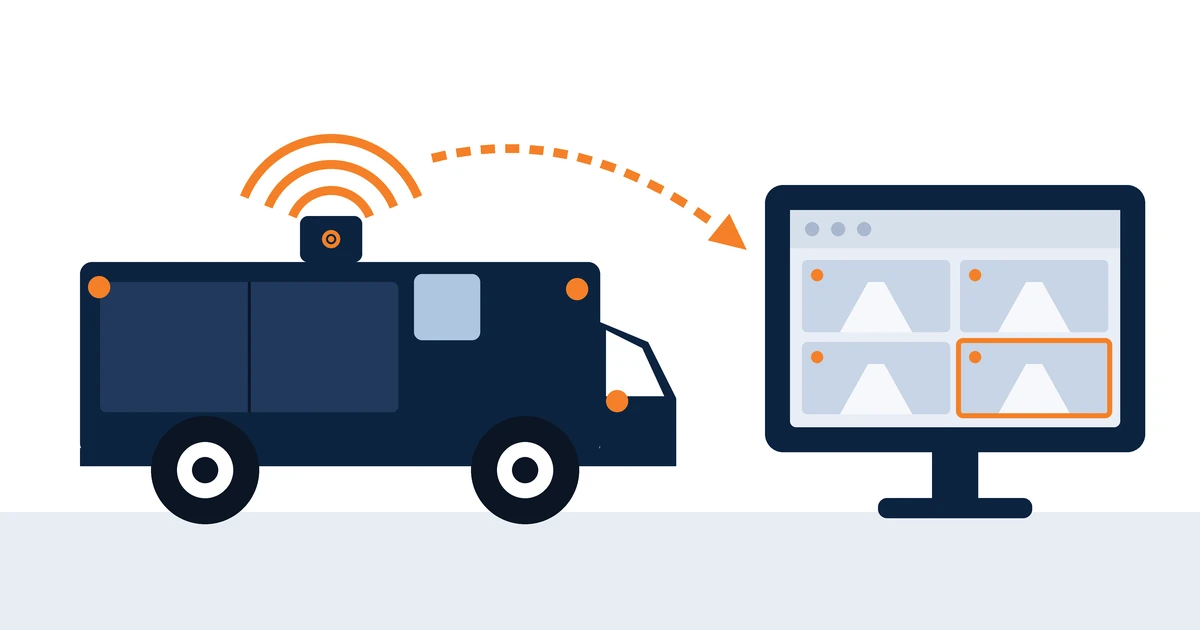
Ask a fleet manager where their incidents happen and the answer is rarely “straight ahead at speed”. It is far more often reversing, maneuvering at a delivery point, moving off from rest in traffic, the nearside during a turn, or something happening at the back of the vehicle during loading.
Then look at where most vehicle cameras point.
The mismatch
A single forward-facing camera covers the direction where the fewest incidents occur on most commercial vehicles — and where the vehicle is, in fairness, easiest to defend anyway. Highway collisions have witnesses, damage patterns and physics that support reconstruction. Yard maneuvers and curbside incidents have none of those.
The result is a familiar and expensive pattern: a fleet with cameras that cannot produce footage of the incidents it actually has.
Where the severe events actually are
The official figures point the same way, and they point at the sides and the back of the vehicle rather than the front.
The Health and Safety Executive puts it plainly: nearly a quarter of all deaths involving workplace transport occur during reversing. That is the one direction a forward camera can never see.
Being struck by a vehicle is also the second most common way to be killed at work. Of the 126 workers killed at work in Great Britain in 2025/26, 24 were struck by a moving vehicle — second only to falls from a height. The figures are provisional until they are finalized in July 2027.
On the road, the side of the vehicle is where severity concentrates. Across 2021 to 2025 the Department for Transport records 4.8% of pedal cycle casualties killed where the other vehicle was a single heavy goods vehicle — the highest proportion of any combination, against 0.3% for a car and 0.7% for a light goods vehicle.
That is a measure of severity, not frequency. The same figures show 41 cyclists killed in collisions with one heavy goods vehicle, against 203 killed in collisions involving a car, which is far more deaths from a far larger number of collisions. What marks out the heavy vehicle is how often a collision is fatal, and the maneuvers that produce those collisions, such as a left turn across a cyclist on the inside, happen beside the cab, where a forward camera sees nothing.
None of this argues against a forward-facing camera. It argues that a forward camera on its own is pointing away from where most of this happens.
Nearside is the curb side on UK roads: the left-hand side of the vehicle.
Where incidents actually occur, by vehicle type
Multi-drop delivery vehicles. Reversing into constrained spaces, curbside contact during loading, damage done while the driver is away from the vehicle, and disputes about whether a delivery was made at all. A rear camera and a load-area view do more work here than a forward camera.
Heavy goods vehicles in urban areas. Nearside collisions with cyclists during left turns, and moving off from rest with a pedestrian in the blind spot immediately in front of the cab. These are among the most severe outcomes in the whole category, and a forward camera captures neither.
Refuse and municipal vehicles. Reversing, operatives working around a moving vehicle, hopper and lift operations, and third-party contact in narrow streets. Multi-view coverage is close to essential.
Tippers and construction vehicles. Reversing on site, maneuvering among people on foot, tipping incidents, and damage claims from sites.
Coaches and passenger vehicles. Interior incidents, boarding and alighting, door areas, and allegations from passengers. Interior coverage frequently matters more than exterior.
Plant and machinery. Slewing, blind spots around the machine, and people on foot in places they should not be.
What multi-camera recording changes
A ruggedized multi-channel recorder handles four, eight or more cameras in sync — front, nearside, offside, rear, interior, load area and specialist views. Synchronization is the point: an incident can be reviewed across several angles on one timeline, alongside speed, braking and steering data.
The practical difference in a disputed incident is stark. One angle invites interpretation. Four angles on a common timeline produce a sequence that is very difficult to argue with.
What that footage is worth once a claim is disputed is covered in how video evidence changes an insurance claim.
How connected cameras capture and upload footage in the first place is explained in what video telematics is.
The near-miss argument
There is a second reason multi-view coverage matters, and it is arguably more valuable than the evidence case.
Collisions are rare. Near misses are not. A vehicle passing closer to a cyclist than it should, a reverse that stopped just in time, a pedestrian stepping out unseen — these happen constantly and are almost never reported, because nothing happened.
Cameras covering the areas where near misses occur turn them into reviewable events. That is the difference between learning from your collisions — a small, expensive and grim sample — and learning from the far larger population of events that cost nothing.
It also changes what you are managing. Reviewing near misses means addressing the conditions that produce collisions — a blind approach to a loading bay, a route with a tight nearside turn, a reversing routine nobody has questioned — rather than waiting for the outcome.
How to specify coverage without over-buying
Rather than starting from a camera count, work backwards from your own incident history:
- List the last three years’ incidents. Mark where each one occurred relative to the vehicle.
- Identify the top three locations. For most commercial fleets this is some combination of nearside, rear and load area.
- Specify coverage for those. Add a forward-facing camera regardless: it is usually the cheapest camera to add, and it covers the highest-speed events.
- Consider the near-miss case separately. Where vulnerable road users are present, nearside coverage earns its place even if no collision has yet occurred there. That is precisely the point.
- Check storage and data implications. Eight cameras generate considerably more data than two. Confirm how long footage is retained and what the monthly data allowance actually supports.
Blind spots around heavy vehicles are covered in more depth in the guide to DVS Phase 2 and the Progressive Safe System.
The question that exposes the gap
Take your three most expensive incidents from last year. For each, ask: “Would our current camera configuration have shown what happened?”
If the answer is no more than once, the configuration is not matched to the risk — and that is a specification problem, not a technology problem.
Sources: Health and Safety Executive — Workplace transport: Reversing, guidance (nearly a quarter of all deaths involving workplace transport occur during reversing). Health and Safety Executive — Work-related fatal injuries in Great Britain, 2025/26, provisional, updated 30 June 2026 (126 workers killed; 24 struck by a moving vehicle; 31 falls from a height). Department for Transport — Reported road casualties Great Britain: pedal cycle factsheet, 2025, published 30 July 2026, table 3, covering 2021 to 2025 (collisions with one heavy goods vehicle: 41 pedal cyclists killed, 4.8% of casualties fatal; one car: 203 killed, 0.3%; one light goods vehicle: 0.7%).