
 English
 English (US)
 English (AU)
 English (NZ)
 English (SA)
 Français
 Français (CA)
 Italiano
 Deutsch
 Español
 Nederlands
 Português
 Polski
 العربية
 עברית
עברית Svenska
 Dansk
Dansk Suomi
Suomi Norsk
Norsk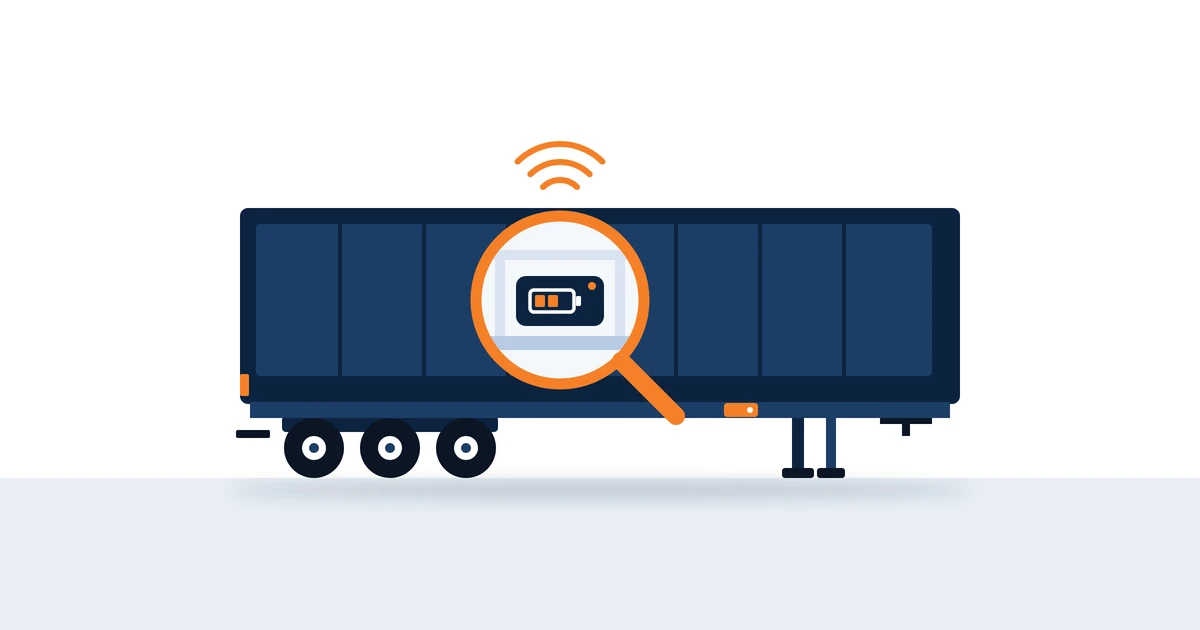
Powered equipment is the easy part. A machine with an engine has electricity, predictable use and a system that can be read directly. Wire in a device and you get engine hours, fuel, fault codes and position.
The difficulty is everything else, and in many operations everything else is the majority.
The plant trailer that left the yard three weeks ago. The four hundred skips distributed across a region. The generators, pumps, cages, welfare units, barriers and toolboxes that move between sites on whichever vehicle has room. These carry real replacement value and generate real revenue, and in many organisations nobody can say with confidence where all of them are right now. If you want the wider picture first, start with the plain-English guide to asset tracking.
Three technologies, three jobs
Battery-powered GPS trackers. The workhorse. Self-contained, weatherproof, and capable of years of life if configured sensibly. Suitable for anything worth locating individually: trailers, generators, plant attachments, cabins and high-value site equipment. For the devices themselves, see GPS asset tracking.
Bluetooth tags. Small, inexpensive and long-lived. A tag does not know where it is; it is detected by a nearby reader, typically a vehicle-mounted gateway, a site beacon or a phone. You get “last seen at this location, at this time” rather than a live position. Right for tools, small equipment and anything where cost per item matters more than precision. For the hardware itself, see Bluetooth asset tags.
Solar-assisted trackers. A battery device with a small panel, for assets that live outdoors permanently. The panel extends battery life considerably, provided it is mounted where it sees daylight and does not spend six months under a tarpaulin.
Matching technology to asset
The mistake to avoid is applying one approach to everything. A useful sorting rule:
| Asset profile | Approach | Why |
|---|---|---|
| High value, moves between sites | Battery GPS tracker with adaptive reporting | Needs individual location and immediate theft alerting |
| High value, static for long periods | Battery tracker at a low reporting rate, plus a motion alert | Long life; the alert matters more than the routine report |
| Medium value, circulating in volume | Battery tracker at a low reporting rate | Visibility of the whole pool rather than minute-by-minute detail |
| Low value, high volume, travels with vehicles | Bluetooth tags with vehicle gateways | Cost per item makes covering the whole pool viable |
| Returnable items in customer circulation | Tags plus dwell reporting | Shows who is holding your equipment and for how long |
| Outdoor permanent placement | Solar-assisted tracker | Very long life, as long as it sees daylight |
Mounting: where most of the value is won or lost
A tracker fitted in an obvious position, removable in under a minute, provides very little protection. The mounting decision matters as much as the device.
Conceal it. Inside a frame member, under a panel, within a housing that requires tools. Somewhere that takes time to find and time to remove.
Fit two on high-value assets. One reasonably findable, one genuinely hidden. A thief who searches and finds one device will often stop looking, and the second device is what recovers the machine.
Choose the mounting method for the environment. Adhesive tends to fail on dirty, oily, cold or textured surfaces. Bolted or welded mounts survive; magnetic mounts are convenient and come off.
Mind the metal. Fully enclosing a device in a steel box degrades both satellite reception and transmission. Some line of sight, or at least a non-metallic section, materially improves reliability.
Consider daylight for solar. Obvious, and regularly overlooked when the asset spends its life sheeted over.
Trailers deserve their own thought
Trailers are easy to overlook in a transport operation, and they are among the most valuable assets to track. There are a great many of them: Driver and Vehicle Standards Agency testing data records 75,984 trailers presented for their annual test in Great Britain between April and June 2026 alone.
They spend most of their life detached from a tractor unit. They are frequently the constraint on utilisation: an operation short of trailers rather than trucks is an expensive situation that tends to go unnoticed until it is measured. They are stolen, sometimes with the load. And they generate a specific and recoverable cost in demurrage and detention, where a trailer sits at a customer site far longer than the agreement allows and nobody is counting.
A trailer tracker with a load or coupling sensor answers the question that actually matters: is it loaded, and is it earning? Position alone answers a much less useful question.
The realistic expectation on theft
Tracking improves the odds of recovery, particularly in the first hours. Recovery rates for untracked plant are widely described as poor, although no UK body publishes a national figure for them, and once identifying marks are removed, tracing becomes close to impossible. The stakes are not small: the Home Office’s economic note for the Equipment Theft (Prevention) Act, as updated in March 2026, puts the economic and social cost of organised plant theft, meaning the theft of construction and agricultural equipment, at £675 million in 2025/26 prices.
But be clear-eyed. Determined, organised groups look for trackers, and some use signal jammers. What tracking reliably changes is the timeline: an alert at the moment of movement rather than a discovery on Monday morning, and a location for the police rather than a description.
A tracker does not stop a determined thief. It changes how soon you know, and what you can tell the police.
That last point matters more than it sounds. Home Office crime outcomes figures for the year ending March 2026 show that 69.4% of theft offences recorded by the police in England and Wales were closed with no suspect identified, and 83.2% of vehicle offences. Those figures cover all recorded theft rather than plant or trailers specifically, but they show what a report without a location is up against. There is more on the theft itself in the article on plant and machinery theft.
The response plan matters as much as the device
An alert is only as useful as what happens next. Who receives the 2am alert. Who is authorised to act. What they do. Who calls the police, and with what information ready. Organisations that recover equipment have answered those questions in advance. Organisations that have not done so receive an alert and read it at nine the next morning.
Sources: Driver and Vehicle Standards Agency — Commercial vehicle testing data for Great Britain, table COM01, updated 10 September 2026 (75,984 trailer annual tests, April to June 2026). Home Office — Crime outcomes in England and Wales 2025 to 2026, published 23 July 2026 (69.4% of theft offences and 83.2% of vehicle offences closed with no suspect identified, year ending March 2026). Home Office — Equipment Theft (Prevention) Act: economic note, updated 10 March 2026 (£675 million economic and social cost of organised plant theft, 2025/26 prices).