Asking yourself the right questions — a structured self-assessment for organisations to work through before they speak to a single supplier, including us. Free, 17 pages, no product pitch.
Every one of those figures is an average across an industry. None of them is your number. The guide exists to help you find yours — because a business case built on somebody else’s statistics will not survive its first encounter with your finance director.
They were caused by buying a system before anyone had written down what problem it was meant to solve. The symptoms are familiar: a platform three people log into occasionally, reports nobody reads, a renewal that arrives with no evidence of benefit, and a workforce that resents something whose purpose was never explained to them.
We sell asset tracking, vehicle telematics and AI video systems, so we have a commercial interest in you buying one. We also have a commercial interest in you buying the right one, switching it on, and still valuing it in year three. Deployments that fail are expensive for everybody — and this guide contains the questions we would rather you asked us.
Seven diagnostic sections covering safety and risk, cost and efficiency, compliance, customers, equipment, people and data — with the honest note that an unanswered question is itself a finding.
An eighteen-line baseline table to capture before you buy anything, four rules that keep the numbers credible, and the questions that test whether the case survives being halved.
Score every problem against six criteria, plot them, pick three — and write down what you are deliberately not solving, which is what stops scope creep during procurement.
Targets with numbers attached, an accountable owner, a review date, and the line most people skip: the point at which you would abandon or change course.
Twenty-two questions across fit, reality, cost, data and privacy, support and roadmap — the ones that separate serious proposals from good presentations.
Twelve confirmations to make before signature, and nine warning signs to watch for during procurement.
Fig. 1 — The cost of an incident. The visible claim figure is rarely more than a fraction of the whole.
Fig. 2 — Risk zones around a commercial vehicle. Plot last year’s incidents onto it: the zones that light up are the ones you are buying for.
Fig. 3 — The five controllable cost pools. Write a number on each line; every blank is a cost you are currently managing by instinct.
Complete the short form below and the guide will be ready to download straight away. We will not pass your details to anyone else.
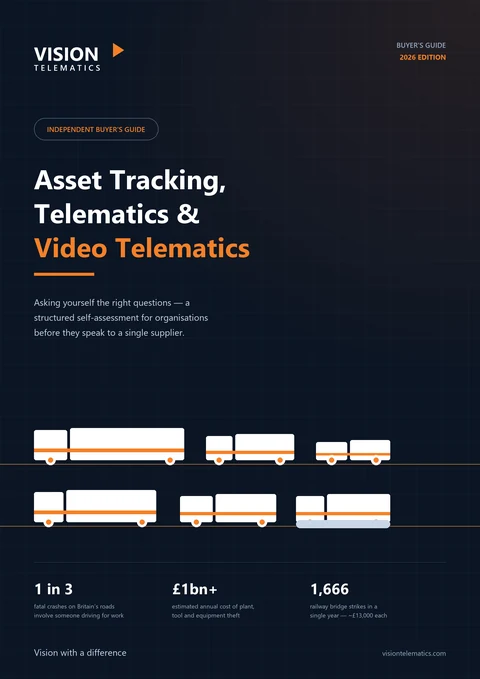
Click the cover to download the guide as a PDF. If you asked us to get in touch, someone from the team will be in contact shortly.
Download the PDF →
Work through the guide and you will know more about your operation than most buyers do at the point of signature. Show us your answers and we will tell you honestly which parts of your problem we solve well, which parts we solve adequately, and which parts you should be talking to somebody else about.

 English
 English (US)
 English (AU)
 English (NZ)
 English (SA)
 Français
 Français (CA)
 Italiano
 Deutsch
 Español
 Nederlands
 Português
 Polski
 العربية
 עברית
עברית Svenska
 Dansk
Dansk Suomi
Suomi Norsk
Norsk