
 English
 English (US)
 English (AU)
 English (NZ)
 English (SA)
 Français
 Français (CA)
 Italiano
 Deutsch
 Español
 Nederlands
 Português
 Polski
 العربية
 עברית
עברית Svenska
 Dansk
Dansk Suomi
Suomi Norsk
Norsk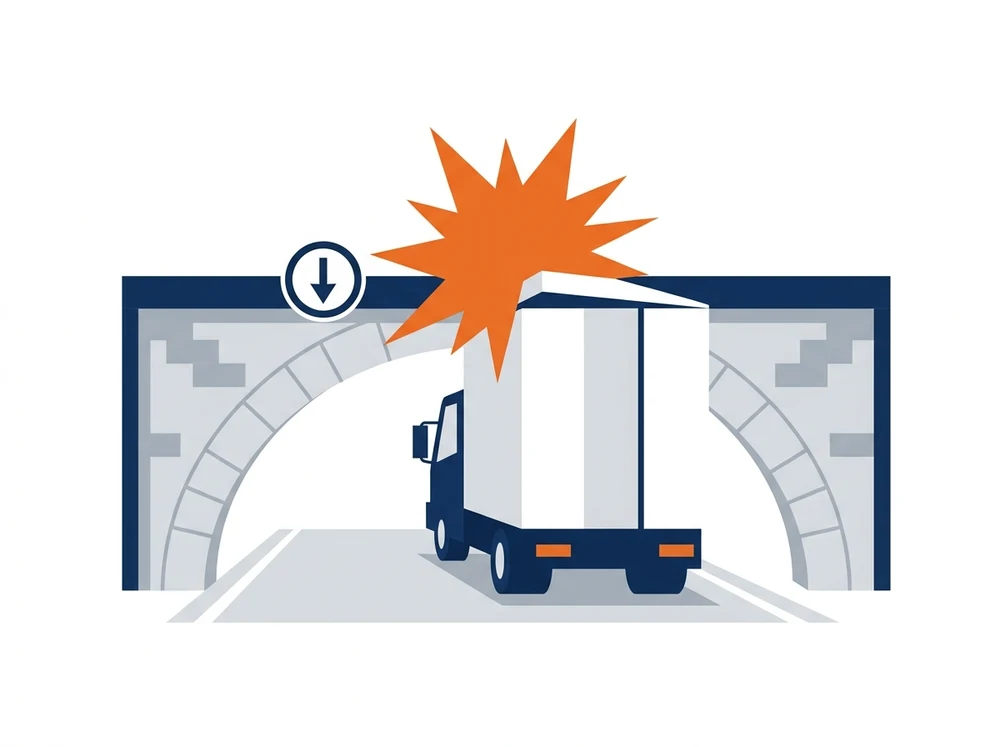
Somewhere in Britain today — statistically, about five times — a lorry or bus driver will discover that their vehicle doesn't fit under the bridge in front of them.
Network Rail's latest figures record 1,666 bridge strikes between April 2024 and March 2025 — roughly one every five hours. Each strike costs around £13,000 in repairs, inspections and train delay compensation, adding up to approximately £23 million a year landed on the taxpayer and the industry. Last year alone, strikes caused around 120 days' worth of train delays. And behind the averages sit the outliers: a single strike on an A12 bridge in Essex triggered a repair programme costing £2.5 million.
The most sobering part? Network Rail's own research found 43% of lorry drivers admit to not measuring their vehicle before setting off, and 52% admit they don't take low bridges into account when planning their route.
Why bridge strikes keep happening
Nobody hits a bridge on purpose. Strikes happen because of a chain of entirely predictable failures:
- Car sat nav in a truck cab. Consumer navigation apps route a 4.2-metre trailer exactly as they'd route a hatchback — straight under a 3.9-metre arch. It remains the single most common root cause.
- Unknown vehicle height. Drivers swap between units, trailers and bodies; the height on the cab sticker doesn't always match what's coupled behind them today.
- Diversions and last-minute rerouting. A closed road pushes the driver off the planned route and onto local roads the risk assessment never covered — where most low bridges live.
- Agency and unfamiliar drivers. Regular drivers know "their" bridges. Cover drivers don't.
For the operator, the consequences stack fast: vehicle and load damage, prosecution and licence points for the driver, DVSA and Traffic Commissioner scrutiny of the operator's licence, Network Rail cost recovery, and an insurance claim that reprices the whole fleet at renewal.
Designing out the risk: truck-specific navigation and routing
Bridge strikes are one of the few fleet risks that can be almost entirely engineered away, because the hazard is fixed, mapped and known. The solution is routing and navigation built for commercial vehicles:
- Vehicle-profile routing. Professional truck navigation holds each vehicle's height, weight, width, length and load type, and only ever offers roads that vehicle can legally and physically use — low bridges, weight-limited structures and narrow lanes are excluded from the route before the wheels turn.
- Safe rerouting. When traffic or closures force a diversion, the recalculated route respects the same vehicle profile — the moment of improvisation that causes so many strikes simply never happens.
- Compliant route planning at the office. Planning teams can build and dispatch approved, truck-legal routes with accurate ETAs, so the safe route is also the scheduled route, and customer promises are built on roads the vehicle can actually take.
- Last-line-of-defence alerts. In-cab low bridge detection and warning systems provide an audible alert as a final safeguard if a driver strays towards a mapped low structure — belt and braces for mixed and agency-driven fleets.
Combined with telematics, operators get the full loop: planned route versus actual route, alerts on deviation, and an audit trail demonstrating to insurers and the Traffic Commissioner that bridge strike risk is actively managed.
The compliance dimension
The Traffic Commissioners have made clear that bridge strikes are viewed as a serious operator licensing matter, and Network Rail actively pursues cost recovery from operators. "The driver should have known" is not a defence when the operator provided no truck-specific routing tools. Equipping vehicles properly is fast becoming part of the definition of professional operation — exactly as it has with cameras and blind-spot equipment.
How Vision Telematics can help
Vision Telematics supplies professional truck navigation and commercial routing and scheduling software with full vehicle-profile routing, integrated with our telematics platform for route compliance monitoring — plus in-cab low bridge detection and warning systems as a physical last line of defence. One supplier, one platform, and a bridge strike risk you can finally engineer down towards zero.
Sources: Network Rail, "Wise Up, Size Up" campaign and bridge strike statistics 2024/25; Network Rail driver research; New Civil Engineer / Network Rail 2023/24 data.