
 English
 English (US)
 English (AU)
 English (NZ)
 English (SA)
 Français
 Français (CA)
 Italiano
 Deutsch
 Español
 Nederlands
 Português
 Polski
 العربية
 עברית
 Svenska
 Dansk
 Suomi
 Norsk
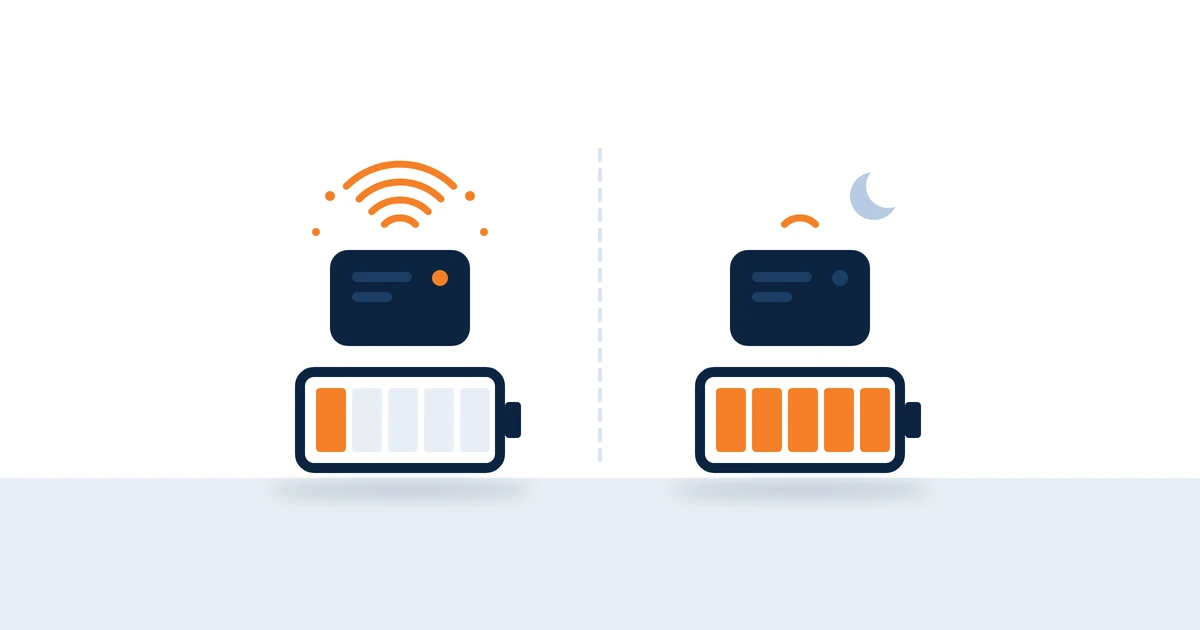
Two identical trackers. One runs for years. The other needs a new battery within weeks.
The hardware is the same. The difference is a configuration setting that most buyers never discuss, and it is one of the most consequential specification decisions in asset tracking. If the basics are new to you, start with the plain-English guide to asset tracking.
Where the power actually goes
A battery tracker spends nearly all its life asleep, drawing almost nothing. Power is consumed in bursts, and the bursts are what matter.
Getting a position fix. The satellite receiver has to wake, find satellites and calculate a position. From a cold start this can take some time, and it is one of the two largest power draws in the cycle.
Transmitting. Connecting to the mobile network and sending data is the other. Transmitting in poor signal costs disproportionately more, because the device raises its power to reach a distant mast, which is why the same tracker lasts noticeably longer in a well-covered yard than in a remote quarry.
Everything else, from the motion sensor to the clock and the sleep state, is negligible by comparison.
So battery life is essentially a function of how many times a day the device wakes up, takes a fix and transmits. Reporting once a day can mean years of life; reporting every couple of minutes can mean weeks. Same device.
The question to answer before you buy
Not “how long does the battery last?”, because the answer means nothing without a reporting frequency attached. The right question is: what do I actually need to know, and how quickly?
Work it through by asset type:
Static site equipment. Welfare units, cabins and generators on long-term placements. You need to know if it moves. Daily reporting plus an immediate motion alert is entirely sufficient, and can give years of life.
Circulating equipment. Trailers, skips and cages moving between sites every week. Two to four reports a day, plus motion-triggered reporting while in transit.
High-value plant. Where theft response time is the priority. Frequent reporting while moving, infrequent while still. This is where adaptive behaviour matters most.
Assets on hire, billed by time or use. Reporting frequency is driven by billing accuracy rather than security. Daily is usually plenty; engine-hours data matters more than how often the position is reported.
Adaptive reporting: having both
Better devices vary their behaviour by state: asleep and reporting rarely when stationary, awake and reporting frequently the moment motion is detected.
This is the configuration most operations should want, because it resolves the trade-off. The asset sits in a yard for weeks costing almost no power, then reports every couple of minutes the moment it is moved at 3am, which is exactly when frequent reporting is worth having.
An illustration of the trade-off, not a specification. Real battery life depends on the device, the network and the signal.
Confirm two things: how the device decides that motion has occurred, and how quickly it switches modes. A device that takes fifteen minutes to notice movement and start reporting has lost the part of a theft that matters most.
The network choice matters more than people expect
Devices designed for this job generally use low-power versions of 4G, known as LTE-M and NB-IoT, rather than a standard mobile connection. These are built for small, infrequent messages and are considerably more power-efficient for each message.
They also generally reach further into buildings and structures than a standard signal, which helps when the tracker is inside a metal cabinet, a container or a plant room.
Coverage is still not complete. Ofcom’s spring 2026 Connected Nations update, published in May 2026, predicts good outdoor 4G coverage across 96% of the UK landmass from at least one mobile network, but only 84% from all of them. Coverage differs by country and by network, so if you operate across borders, confirm it rather than assuming it.
Check, too, that the device does not depend on 2G. Government guidance, last updated in July 2026, says the UK’s mobile network operators will switch off their 2G networks between 2029 and 2033, and that devices which can only use 2G will need upgrading to 4G or 5G to stay connected.
Replaceable or sealed?
Sealed. Sealed units are better protected against water and dust, and are commonly the more robust choice for harsh environments. When the battery is exhausted, the unit is replaced.
Replaceable. Replaceable batteries extend the life of the unit and reduce waste, but every serviceable opening is a potential way in for water and dust. For assets that live outdoors permanently, sealed is generally the safer choice.
Either way, check how far in advance you are warned of a low battery, and whose job it is to act on it. A tracker that dies silently is worse than no tracker, because it gives false assurance.
The mounting question that undoes everything
A tracker fixed where it can be seen and removed in thirty seconds is not a theft deterrent. It is a short delay for a thief who knows what to look for.
Concealed mounting, tamper detection and, on very high-value assets, a second hidden device all matter. The second device defeats the assumption that finding one means the job is done, and it is one of the most effective measures available for machines worth recovering. Where and how to fit one is covered in the guide to tracking non-powered assets.
The practical checklist
- What is the stated battery life, at what reporting frequency, and in what signal conditions?
- Does it report adaptively based on motion, and how quickly does it switch?
- How far ahead is a low battery flagged, and on which report?
- What network technology does it use, and is it supported everywhere we operate?
- Is it sealed or serviceable, and what is the ingress protection rating?
- What happens if someone removes it? Is there a tamper alert, and who receives it?
- Can the reporting frequency be changed remotely, or does it need physical access?
That last one is worth more than it appears. Requirements change. A device whose behaviour can only be altered by sending someone to find it is a device you will never reconfigure. The questions to put to a supplier on everything else are set out in the fleet technology buyer’s guide.
Sources: Ofcom — Connected Nations update: Spring 2026, published 13 May 2026 (good outdoor 4G coverage predicted across 96% of the UK landmass from at least one mobile network, 84% from all networks). Department for Science, Innovation and Technology and Department for Culture, Media and Sport — Preparing for the 2G switch-off: mobile phones and smart devices, published 24 March 2026, last updated 29 July 2026 (2G networks switched off between 2029 and 2033; devices that can only use 2G need upgrading to 4G or 5G).